
Bitcoin Miner IREN’s Shares Slide as AI Buildout Costs Rattle Investors
Solana validators approved the network’s first binding governance vote by a razor margin, doubling disinflation to 30% and tightening the SOL supply schedule, while a companion fee-burn measure’s fate remained disputed across sources.

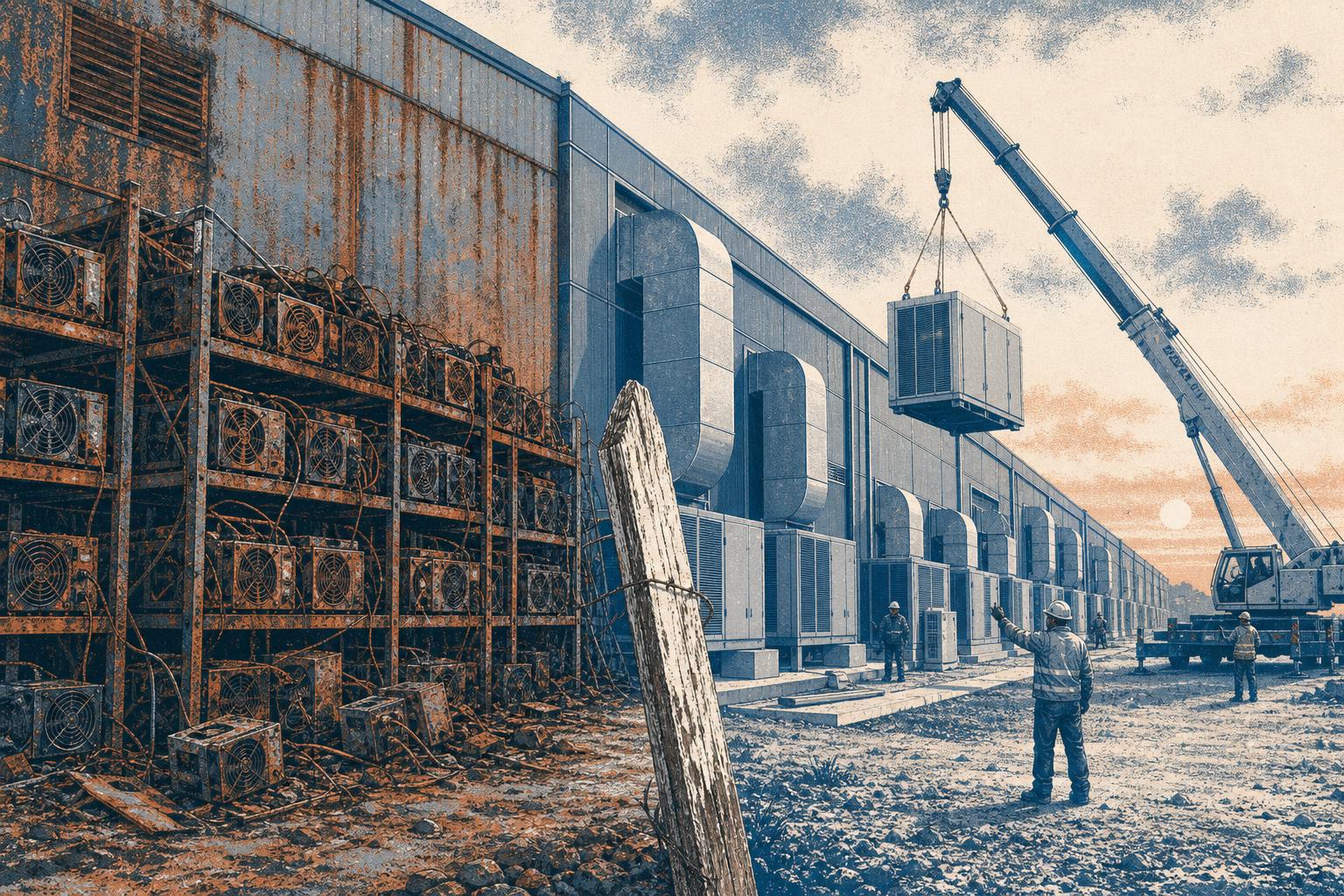
Bitcoin miner IREN’s shares fell more than 8% after it posted a $684 million quarterly loss, even as AI cloud revenue overtook mining sales for the first time.
The stock closed Thursday at $40.53. By after-hours trade it had shed 8.2% to $37.19, according to Decrypt. The Block recorded a 6.3% dip to $37.96 in pre-market trading on Friday. Same close, different snapshots.
The loss puts a dollar figure on the pivot. IREN booked $450.4 million in asset impairments and another $127.2 million in write-downs on equipment held for sale or disposed of, mostly retired mining rigs, as it converted mining sites for AI workloads, Decrypt reported. Mining revenue dropped 40% from the prior quarter to $66.7 million. AI cloud revenue, meanwhile, climbed to $70.5 million and made up 51.4% of the quarter’s $137.2 million in total revenue. Adjusted EBITDA fell 68% to $19.2 million, down from $59.5 million. The company pointed to higher employee costs and front-loaded investment in its AI cloud expansion.
Full-year fiscal 2026 told the same story at scale. Revenue rose 41% to $707 million. But $638.8 million in impairments dragged IREN to a $702.6 million loss, reversing an $86.9 million profit from a year earlier. AI cloud revenue for the year hit $128.8 million, up nearly eightfold from $16.4 million. Mining brought in $578.2 million, up 19%.
Bernstein analysts, led by Gautam Chhugani, wrote in a Friday client note that IREN’s $25 billion to $30 billion fiscal 2027 capital expenditure guidance may have “spooked the market.” They held an Outperform rating and a $100 price target against the $40.53 close, implying 147% upside.
“The high capex number may have spooked the market, but the investors seem to ignore improving unit economics with faster payback on incremental capex,” Chhugani wrote, according to The Block.
The unit economics are shifting. Under its Microsoft agreement, IREN generated about $10 million in annual revenue per IT megawatt. Recently signed three-year contracts pushed that above $20 million. The company is now discussing three-to-five-year deals at around $25 million per megawatt, The Block reported. Bernstein estimates the GPU capex payback period has dropped to roughly two years, versus about three under IREN’s 2025 Microsoft contract.
IREN has $4 billion in contracted annualized run-rate revenue scheduled to operate by year-end. Of that, $1 billion was operating as of Aug. 26, with $700 million tied to its Nvidia contract expected in 2027. The company secured $6.4 billion in GPU financing, including $3.6 billion at a 6% weighted-average interest rate for its $9.7 billion, five-year AI cloud agreement with Microsoft. Financing and Microsoft’s prepayments cover 96% of the related costs, Decrypt reported. In May, IREN signed a $3.4 billion, five-year AI cloud contract with Nvidia covering managed GPU services and up to 5 gigawatts of infrastructure.
Over the past 12 months, IREN pulled in $19 billion through customer prepayments, GPU financing, convertible debt and equity issuance. Roughly $14 billion remains in cash or undrawn, according to The Block. Bernstein expects another $8 billion from new financing and prepayments, with the remaining $3 billion to $8 billion coming from operating cash flow and data center financing.
Daniel Roberts, IREN’s co-founder and co-CEO, said in the earnings release that site optimization was increasing the revenue potential of every megawatt. “With increasing availability of a broad range of capital sources to fund our expansion, we are well positioned to keep compounding as the structural shortage of compute deepens,” he said.
Bernstein expects IREN to wind down Bitcoin mining by 2030 as it replaces mining hardware with GPUs. James Butterfill, head of research at CoinShares, said Thursday that grid connection times for new U.S. facilities now average roughly five years, benefiting miners like IREN that already control powered infrastructure.